20 Hz – 20 kHz
Tone Generator
Generate any pure tone or waveform and adjust it live. Useful for testing speakers, hearing range and tuning.
Next step: Left/right, rattle, bass and treble checks.
Open Speaker Test →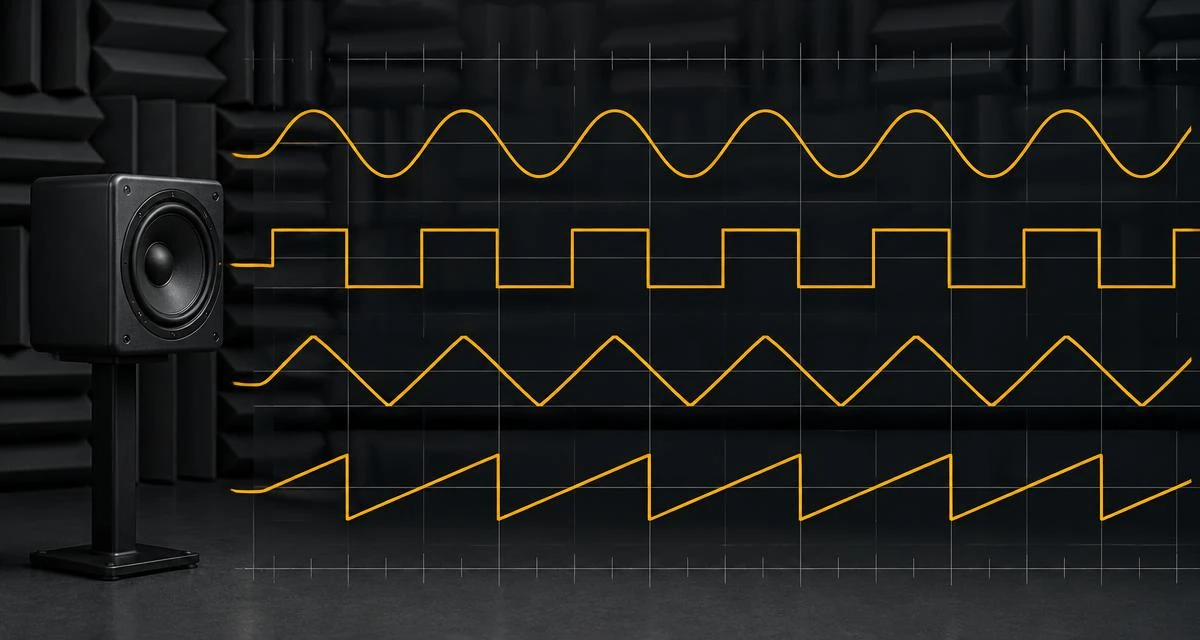

Common uses
- Find the lowest note your speaker can reproduce.
- Locate a rattle by sliding until the buzz appears.
- Check your upper hearing limit (keep volume low).
For cleaning, use the dedicated speaker cleaner with timed sessions.
Understanding frequency and waveform
Frequency is how many times per second the speaker cone moves back and forth, measured in hertz (Hz). Low numbers are deep tones; 440 Hz is the standard tuning note A; 1,000 Hz is a common audio test reference. The slider uses a logarithmic scale because human hearing perceives pitch that way. Each step to the right sounds like an even jump in pitch.
A sine wave contains a single frequency. Square and sawtooth waves add many harmonics above the base frequency, so a speaker reproducing them works across a wider range at once. Triangle sits between the two, with softer harmonics.
Practical tests you can run
- Bass extension: start at 20 Hz on sine and slide up slowly; note where you first hear a clean tone.
- Rattle hunting: slide through 60–300 Hz at moderate volume and listen for objects or panels buzzing.
- Instrument reference: play 440 Hz and tune by ear, remembering browser output is not a calibrated tuner.
- Room resonance: some bass notes will sound much louder in certain spots of a room. That is the room, not the speaker.
Safety boundaries
Keep volume low, especially above 8 kHz and with headphones. Avoid long sessions of constant tones, give your ears breaks, and do not play loud tones near pets, which hear higher frequencies than people.
Related tools & guides
Frequently asked questions
+What frequency range can I generate?
20 Hz to 20,000 Hz, the commonly cited range of human hearing. What you actually hear depends on your speakers and your ears.
+What's the difference between the waveforms?
Sine is a pure tone. Square, sawtooth and triangle add harmonics, sounding buzzier, useful for checking distortion.
+Can high frequencies damage my hearing?
Any loud sound can. Keep volume low, especially with headphones and at high frequencies you may not perceive as loud.